It's World Restart a Heart Day: The Simple Skill That Doubles Survival When a Heart Stops
· 6 min read · David Onori
Today, October 16, 2026, people around the world are marking World Restart a Heart Day with a clear message: when someone’s heart stops, a bystander’s quick action can help keep them alive until emergency responders arrive.
The campaign’s headline message (that immediate CPR can double or even triple survival) captures why those first minutes matter. It is not a promise of a particular outcome: survival varies with the circumstances and response time. But the evidence is clear that bystander CPR can make a life-changing difference, and learning the basics is within reach for ordinary people.
October is also Sudden Cardiac Arrest Awareness Month in the United States, making this a timely opportunity to learn what to do, refresh your skills, and encourage others to prepare.
A global call to act, not just to raise awareness
Led by the International Liaison Committee on Resuscitation’s World Restart a Heart campaign, World Restart a Heart Day takes place every October 16. Its purpose is practical: increase awareness of bystander CPR and encourage more people to learn and act. The 2026 campaign slogan, “Two hands can save a life,” puts the focus on accessible, immediate help.
A cardiac arrest happens when the heart suddenly stops pumping blood effectively. A person may collapse, become unresponsive, and stop breathing normally, or gasp in a way that is not normal breathing. It is different from a heart attack, although a heart attack can sometimes lead to cardiac arrest.
In that emergency, CPR helps circulate blood while help is on the way. An automated external defibrillator (AED), if available, can assess the heart’s rhythm and deliver a shock when needed. The device provides voice or visual instructions, guiding the user through its steps.
Why bystander CPR matters
Cardiac arrest can happen in public, at work, during exercise, or at home. The Sudden Cardiac Arrest Foundation’s summary of U.S. data reports that about 71% of adult out-of-hospital cardiac arrests occur at home or in a residence. That means the person who needs help could be someone you know.
The same summary, citing the CARES 2024 report, says bystander CPR was started in 41.7% of reported out-of-hospital cases. Survival to hospital discharge was 13.0% among people who received bystander CPR, compared with 7.6% among those who did not. These figures don’t mean CPR guarantees survival, and they don’t predict what will happen in an individual emergency. They do show why an early response matters.
The World Restart a Heart campaign says immediate bystander CPR can double or even triple survival rates. That’s a useful way to communicate the potential impact, but the exact benefit depends on factors such as where the arrest occurs, whether it is witnessed, how quickly CPR and an AED are used, and how soon professional help arrives. The central point remains: waiting for responders without starting CPR means losing valuable time.
What to do if someone collapses
In an emergency, call your local emergency number and follow the dispatcher’s instructions. If you suspect cardiac arrest:
- Check responsiveness and breathing. If the person is unresponsive and not breathing normally, or is only gasping, treat it as an emergency.
- Call 911. Ask someone nearby to call and bring an AED, if one is available. If you are alone, call on speakerphone so you can follow the dispatcher’s directions.
- Start CPR. For an adult who has suddenly collapsed, hands-only CPR, pushing hard and fast in the center of the chest, is a way to begin. If you are trained, follow the CPR skills you learned for the person’s age and situation.
- Use an AED as soon as it arrives. Turn it on and follow its prompts. Resume CPR when instructed.
This is a brief overview, not a substitute for hands-on instruction or emergency-dispatcher guidance. Training lets you practice what to do and build confidence using CPR and an AED. Red Cross and Health & Safety Institute (HSI) training programs offer CPR/AED courses, including options that cover adults, children, and infants.
Training turns good intentions into practiced skills
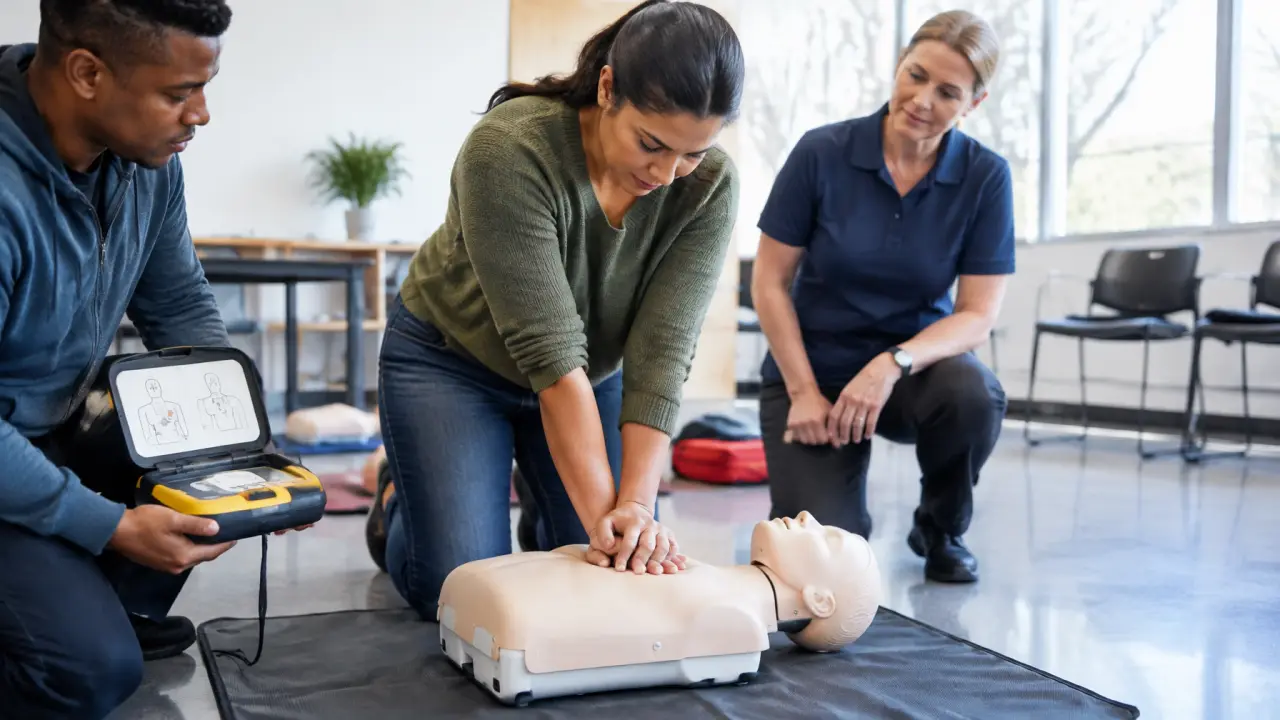
Many people hesitate because they worry they will do something wrong. A course gives you a chance to practice on a manikin, learn how an AED works, and ask questions in a supportive setting. Knowing the sequence ahead of time can make it easier to take the first step when a real emergency happens.
With Code Blue Safety Skills, you can choose First Aid, CPR & AED training through Red Cross or HSI programs. The course covers CPR for adults, children, and infants, AED use, choking response, and essential first aid skills. Depending on the format, you can combine online learning with an in-person skills session or take a fully in-person class.
Training is mobile, so instruction can come to your home, workplace, school, or community group. It can be a practical option for parents and caregivers, teachers, coaches, fitness staff, and organizations preparing a team. The emphasis is on practicing skills, not just hearing about them, so participants can leave better prepared to respond.
Get trained locally
Code Blue Safety Skills serves San Diego County, Temecula, Murrieta, Menifee, and Lake Elsinore, with flexible scheduling for individuals and groups.
Scheduling is appointment only. To request a class, email or call (951) 669-4177, and include the specific dates you want for your class. Mention your preferred course and, if you’re arranging group training, your approximate group size. You can also visit the contact page.
World Restart a Heart Day is a reminder that lifesaving action doesn’t belong only to professionals. Start CPR, call for help, and use an AED when one is available. Then take the next step: practice those skills before someone around you needs them.
Sources
- World Restart a Heart, ILCOR
- Sudden Cardiac Arrest Foundation: Latest Statistics
- American Red Cross CPR training and resources
- HSI First Aid | CPR AED programs
Explore Topics
Written by
David Onori
David Onori is a Trained Emergency Medical Responder (EMR) and Red Cross & HSI certified CPR and First Aid instructor serving Temecula, Murrieta, San Diego, and surrounding Southern California communities. He is a member of the Red Cross Ready Rating Business program. Every class is taught onsite — he comes to you.
Related Posts
It's World Restart a Heart Day: The Simple Skill That Doubles Survival When a Heart Stops
Today is World Restart a Heart Day. Learn why immediate bystander CPR can double survival and what to do if someone collapses.
Oct 16, 2026 · 6 min read · David Onori
The Great ShakeOut Is October 16 — Here's What Happens After the Shaking Stops
The Great ShakeOut drill is a great reminder to drop, cover, and hold on. But the injuries that follow an earthquake — falls, debris strikes, cardiac events from shock — are where CPR and first aid training actually save lives.
Oct 9, 2026 · 4 min read · David Onori
Sudden Cardiac Arrest Awareness Month 2026: How San Diego County and Southwest Riverside Communities Are Getting Ready to Respond
Every October, Sudden Cardiac Arrest Awareness Month reminds communities that emergency readiness begins with ordinary people. Here is what local readiness looks like in 2026 — and how to build it where you live and work.
Sep 25, 2026 · 7 min read · David Onori
The Recovery Position: A Step-by-Step Guide That Could Save a Life
If someone is unresponsive but breathing normally, the recovery position can protect their airway while help is on the way. Here is how to do it — step by step.
Aug 12, 2026 · 9 min read · David Onori