New San Diego Bystander CPR Research: What a Community-Wide Training Push Could Mean for Survival in 2026
· 8 min read · David Onori
A new peer-reviewed study published September 15, 2026, in BMC Public Health brings an important question into sharper focus: What could happen if far more people in San Diego County were prepared to perform bystander CPR?
The study, "Revive & Survive San Diego: Modeling the Potential Impact of a Community Bystander CPR Training Initiative," examines how a large-scale community training effort could affect out-of-hospital cardiac arrest outcomes. Its central message is encouraging. Individual CPR certification is not only a personal skill — it can become part of a broader regional safety network.
The findings arrive as communities nationwide continue to expand CPR and AED education, schools develop cardiac emergency response plans, and safety organizations such as the Health & Safety Institute (HSI) emphasize a practical question: Are AEDs and trained responders actually accessible where people live, work, and play?
What the New San Diego Modeling Study Found
The research builds on the goals of Revive & Survive San Diego, a collaboration involving UC San Diego and San Diego County Emergency Medical Services. The initiative aims to train one million San Diego residents in hands-only CPR and create a countywide network of people ready to respond before professional help arrives.
The model compared current conditions with a scenario in which the one-million-person training goal had been reached. Over a five-year period, researchers projected:
- Approximately 8,445 eligible out-of-hospital cardiac arrest events
- About 1,700 additional cases receiving bystander CPR
- Approximately 470 to 480 additional lives saved
- A substantial increase in the proportion of cardiac arrest victims receiving immediate assistance
These are modeled estimates, not guarantees for any individual emergency. However, they help illustrate the potential value of a community-wide training strategy. When more residents understand how to recognize cardiac arrest, activate 911, begin compressions, and locate an AED, the odds improve that someone capable of acting will be nearby.
The scale is especially important. A single certified person may help one person during one emergency. A trained community can change the likelihood that help is available across neighborhoods, workplaces, schools, recreation centers, and public spaces.
Why Individual Certification Matters in a Population-Level Strategy
Large public-health initiatives depend on individual participation. Community-wide training does not replace formal courses — it creates more opportunities for trained people to respond with confidence.
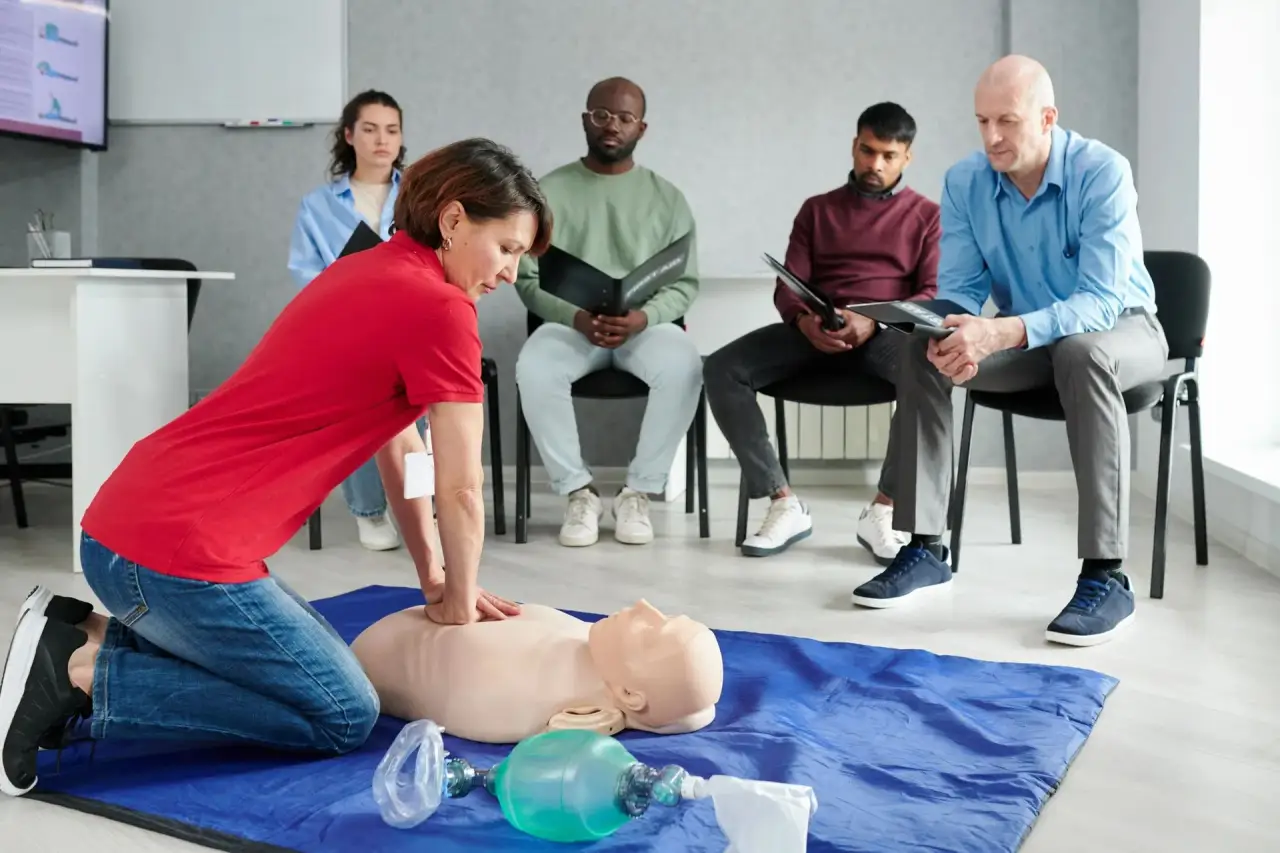
A person who completes a Red Cross or HSI CPR/AED course gains more than information. Hands-on practice helps participants become familiar with:
- Recognizing a possible cardiac arrest
- Calling 911 and communicating clearly with dispatchers
- Performing high-quality chest compressions
- Using an AED according to its prompts
- Working with other bystanders until EMS arrives
- Responding calmly in a public, workplace, school, or family setting
This confidence is valuable because hesitation can delay care. The Revive & Survive San Diego initiative demonstrates the community value of teaching accessible hands-only CPR. Formal certification through a recognized Red Cross or HSI program adds structured instruction, skills practice, and evaluation for people whose responsibilities require current credentials.
For businesses and organizations, group training can also create shared expectations. Staff members know who may call 911, who can retrieve an AED, and who is prepared to begin CPR. That coordination is an important part of turning a safety policy into an effective response.
Technology Helps, but Trained People and AED Access Remain Essential
Another 2026 research development adds useful nuance to the conversation. Smartphone-based community first-responder systems can alert trained volunteers when a suspected cardiac arrest occurs nearby. These systems may provide location information, direct responders to an AED, and encourage earlier intervention.
Research has shown that activating community first responders can increase bystander CPR and AED use. A randomized HeartRunner trial presented at ESC Congress 2026 found that community responder activation increased bystander CPR and doubled bystander defibrillation in some groups.
However, the trial did not demonstrate a statistically significant improvement in 30-day survival. In the study setting, ambulance response times were already very short — approximately seven minutes. When EMS arrives quickly, the additional time available for a community responder to make a measurable difference may be limited.
That finding should not be interpreted as evidence that technology is ineffective. It shows that technology is one part of a larger response system. Smartphone alerts work best when they connect to:
- People who are trained and willing to respond
- AEDs that are visible, maintained, and quickly accessible
- Clear emergency procedures
- Effective 911 and EMS coordination
An alert cannot perform CPR by itself. An AED cannot help if no one knows where it is or feels prepared to use it. Community readiness still depends on trained hands.
Schools Are Becoming a Major Focus of Cardiac Emergency Preparedness
The national movement toward school-based cardiac emergency response plans is another important 2026 trend. Minnesota is a recent example, requiring school districts and charter schools to establish cardiac emergency response plans beginning with the 2026–27 school year.
These plans generally address:
- Designating a cardiac emergency response team
- Training selected staff in CPR and AED use
- Identifying AED locations
- Establishing communication procedures
- Conducting practice drills
- Coordinating with local EMS
- Reviewing and improving the plan annually
The trend has implications well beyond Minnesota. Schools, districts, daycares, athletic programs, and youth organizations in Southern California are also evaluating how quickly their staff can respond to a collapse on campus or during an activity.
A written plan is valuable, but a plan must be practiced. Staff turnover, substitute teachers, changing athletic schedules, locked doors, large campuses, and outdoor fields can all affect response time. Training more than the minimum number of people may help organizations maintain coverage when designated responders are absent.
For local schools and youth programs in Temecula, Murrieta, Menifee, Lake Elsinore, and throughout San Diego County, CPR/AED training can be incorporated into broader 2026 safety goals. Coaches, teachers, daycare providers, administrators, front-office personnel, and activity supervisors may all have a role in building a more prepared environment.
HSI's AED Message: Accessibility Is More Than Ownership
HSI continues to emphasize that AED readiness is not simply a matter of purchasing a device. Organizations should ask whether the AED is accessible where people live, work, and play.
That means considering:
- Is the AED visible and clearly marked?
- Can someone reach it without a key or special permission?
- Is it located close enough to the areas it is intended to protect?
- Are pads and batteries current?
- Do staff know how to retrieve and use it?
- Is the device included in the organization's emergency response plan?
HSI notes that out-of-hospital cardiac arrest survival in the United States remains roughly 10 percent overall. This statistic represents a serious gap, but it also represents an opportunity for improvement — not a reason for panic.
Earlier CPR and defibrillation can improve outcomes. A trained employee, teacher, coach, parent, or bystander may be the person who bridges the critical interval before EMS arrives.
What This Means for You
For individuals, the San Diego modeling study is a reminder that CPR certification has value beyond meeting a workplace or professional requirement. Parents, caregivers, teachers, fitness professionals, community members, and volunteers all contribute to the number of trained responders available in the region.
For organizations, the findings support a broader approach to preparedness:
- Train enough employees to provide reliable coverage
- Include AED locations in emergency procedures
- Offer renewal training before certifications expire
- Practice roles and communication, not just technical skills
- Consider blended learning for flexible scheduling
- Review preparedness for indoor and outdoor activities
I provide mobile, hands-on, and blended First Aid and CPR training for individuals, businesses, schools, daycare centers, fitness facilities, healthcare settings, and community organizations throughout San Diego County, Temecula, Murrieta, Menifee, and Lake Elsinore. Courses include CPR/AED, Pediatric First Aid & CPR/AED, Basic Life Support, Stop Life-Threatening Bleeding, and certification renewals through Red Cross and HSI training programs.
I come to you — mobile instruction means your staff trains at your own location, while blended options combine online coursework with an in-person skills session. Classes are available by appointment only. To schedule, email or call Code Blue Safety Skills with the specific dates you want for the class.
Building a Stronger Local Response Network
The new BMC Public Health study offers a valuable population-level perspective: expanding CPR training across San Diego County could lead to more bystander interventions and hundreds of additional survivors over time.
The technology research adds an equally important lesson. Alert systems can improve CPR and AED use, but their effect depends on the surrounding response system — including EMS response times, AED access, and the presence of people prepared to act.
Together, these developments point toward a practical 2026 priority: make training, equipment, and emergency planning work as a connected system. Every newly trained responder strengthens that system. Every accessible AED improves the opportunity for early defibrillation. Every practiced plan reduces uncertainty.
A safer San Diego region will not be created by one program or one organization. It will be built by individuals and organizations choosing to prepare — one trained person, one AED, and one confident response at a time.
Sources: Revive & Survive San Diego, HSI AED accessibility guidance, Minnesota Model Cardiac Emergency Response Plan, and 2026 HeartRunner trial coverage.
Explore Topics
Written by
David Onori
David Onori is a Trained Emergency Medical Responder (EMR) and Red Cross & HSI certified CPR and First Aid instructor serving Temecula, Murrieta, San Diego, and surrounding Southern California communities. He is a member of the Red Cross Ready Rating Business program. Every class is taught onsite — he comes to you.