The Red Cross Just Updated Its CPR Program: What the New r.25 Changes Mean for Your Certification
· 9 min read · David Onori
The Red Cross Just Updated Its CPR Program: What the New r.25 Changes Mean for Your Certification
The American Red Cross has launched a significant update to its resuscitation training programs. Released on February 3, 2026, the new Resuscitation Suite r.25 brings updated science, digital CPR aids, revised infant CPR techniques, new epinephrine nasal spray training options, and a virtual reality pathway for Advanced Life Support (ALS).
For anyone who holds or needs a Red Cross certification, the update raises an important question: Do you need to retake your course?
The short answer is that an existing certification does not automatically become invalid simply because a training program has been updated. However, healthcare employers, licensing agencies, schools, childcare programs, and other organizations may require certification under the current course version. If your certification is approaching renewal — or if your employer has announced a transition to r.25 — it is worth confirming which program your workplace accepts.
I provide current Red Cross and HSI First Aid, CPR, AED, and Basic Life Support training with practical, hands-on instruction throughout San Diego County, Temecula, Murrieta, Menifee, and Lake Elsinore. Here is what the r.25 update means for learners, instructors, and organizations.
What Is the Red Cross r.25 Resuscitation Suite?
The Resuscitation Suite r.25 is the updated Red Cross education platform for healthcare and resuscitation training. The initial release includes:
- Basic Life Support (BLS)
- Advanced Life Support (ALS)
- Pediatric Advanced Life Support (PALS)
- Neonatal Advanced Life Support (NALS)
The programs are designed for both in-hospital and out-of-hospital clinicians. Instead of focusing only on memorizing an algorithm, the new training emphasizes realistic scenarios, teamwork, decision-making, and practice that reflects how care is delivered in the real world.
The updated programs are aligned with the 2025 International Liaison Committee on Resuscitation (ILCOR) science and were reviewed through the Red Cross scientific advisory process. The goal is to help learners build skills that are current, relevant, and easier to apply during a time-critical emergency.
A New App Provides Digital Code Cards and CPR Aids
One of the most visible changes is the Resuscitation Suite app, powered by Redivus Health. The app combines resources for BLS, ALS, PALS, and NALS in one place.
The app includes digital code cards and reference materials that can help guide care during training and clinical events. Features include:
- Digital Red Cross code cards
- Adult and infant reference cards
- A “Start CPR” or “Give Care” mode
- Compression metronomes
- Ventilation prompts
- Heads-up timers
- Medication reminders and timers
- Real-time event documentation
- Situation reports summarizing the event
These tools are designed to support — not replace — good training and clinical judgment. In an emergency, a digital aid can help a trained responder stay organized, follow the appropriate sequence, and maintain awareness of timing.
The app is also designed for use in classroom practice, skills testing, bedside environments, and field settings. Paper resources remain available for learners and organizations that prefer printed reference materials.
It is important to understand the difference between a digital code card and a digital certification card. A code card is a clinical reference tool — it does not prove that someone has completed a CPR or BLS course. Certification still depends on completing all required cognitive and hands-on components.
Downloading the App Does Not Create a Certification
This point is worth stating clearly because digital tools can create confusion about what certification actually requires.
Downloading the Resuscitation Suite app does not create a certification. Watching an online lesson alone does not demonstrate hands-on competency. Using a timer or digital code card cannot replace the ability to perform effective compressions, use an AED when appropriate, provide ventilations when required, or work safely within a response team.
A valid certification requires completing all applicable course requirements, which may include:
- Completing online learning modules
- Attending an instructor-led session
- Passing knowledge assessments
- Practicing required procedures
- Demonstrating hands-on skills to an authorized instructor
- Meeting the training organization's completion standards
Hands-on practice remains essential because emergencies are physical as well as cognitive. Responders must position themselves correctly, apply proper technique, manage equipment, communicate clearly, and continue acting when stress and uncertainty are present. No app can verify those abilities — only a qualified instructor can.
Infant CPR Training Now Emphasizes Heel-of-Hand Compressions
The r.25 update also reflects changes in how infant CPR is taught.
Current Red Cross training recognizes two primary compression techniques for infants:
- The two-thumb encircling-hands technique, when the rescuer can comfortably encircle the infant's chest.
- The heel-of-one-hand technique, particularly when the rescuer cannot encircle the chest or needs better control and compression depth.
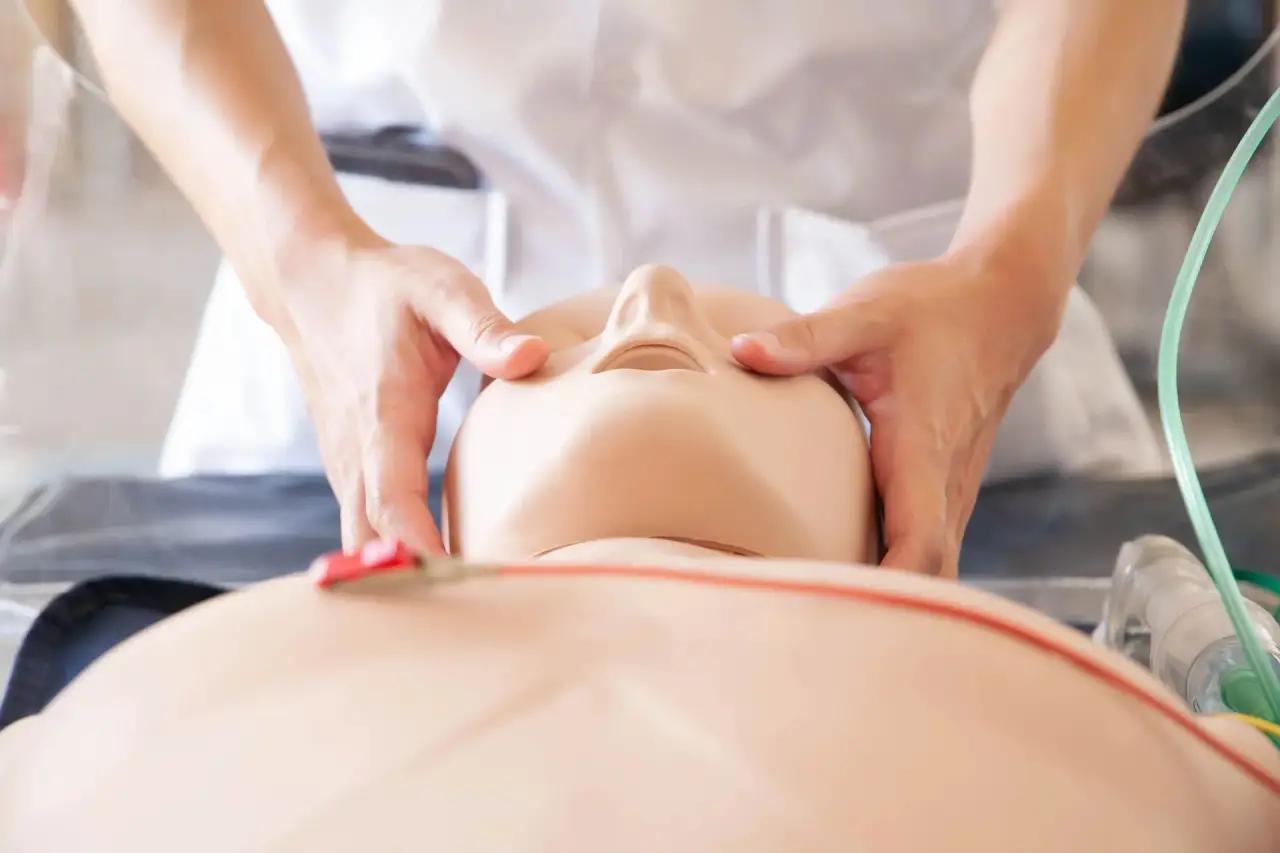
The heel-of-hand technique may feel unfamiliar to people who learned older infant CPR methods. That is exactly why hands-on practice matters. Learners need an instructor to demonstrate correct hand placement, compression depth, body position, and recoil — and then observe the learner performing the skill.
For infant CPR, compressions should generally be delivered at a rate of 100 to 120 compressions per minute and to a depth of approximately one-third the chest's front-to-back diameter, or about 1.5 inches for an average infant.
The update is not simply a change to a picture in a manual. It is a change that learners should physically practice on an infant manikin. Parents, caregivers, teachers, daycare employees, and healthcare professionals may all benefit from reviewing this technique during their next renewal course.
Epinephrine Nasal Spray Is Now an Available Training Option
Another r.25 development involves anaphylaxis and epinephrine administration.
The updated Red Cross First Aid/CPR/AED program refers to the skill as Anaphylaxis and Epinephrine Administration, rather than limiting the lesson to an auto-injector. This reflects the availability of more than one delivery device, including an epinephrine nasal spray.
In courses where this optional content is included, learners may practice how to:
- Recognize signs and symptoms of anaphylaxis
- Identify when emergency medical services should be activated
- Prepare an epinephrine delivery device
- Properly position and use a nasal spray training device
- Note the time of administration
- Monitor the person while waiting for emergency responders
- Provide information about the device and timing to EMS personnel
The auto-injector remains an important core skill, while nasal spray instruction may be added based on the course plan, workplace needs, or organization request.
Epinephrine nasal spray training is part of first aid and anaphylaxis education. It is not the same as the epinephrine medication prompts used in advanced cardiac resuscitation. Students should learn the distinction between responding to a severe allergic reaction and participating in an advanced resuscitation response.
A Virtual Reality Pathway Is Coming to ALS Training
The Red Cross is also introducing a virtual reality pathway that can lead to ALS certification.
In this format, the learner wears a VR headset and acts as the team leader during an advanced resuscitation scenario. Voice commands allow the learner to direct a virtual team, assess the situation, make treatment decisions, and manage the progression of a full code scenario.
This approach is designed to address a common limitation of traditional self-directed manikin practice: the learner may perform individual skills without fully experiencing the communication, leadership, and decision-making required during a team resuscitation.
To use the VR pathway, learners must have:
- A current BLS certification
- Completion of the online ALS cognitive portion
- Successful completion of the final written examination
- Successful completion of the required VR scenario and other course components
Virtual reality can make training more immersive, but it does not eliminate the need for foundational skills. A learner still needs to understand CPR, patient assessment, airway management, defibrillation, medication concepts, team dynamics, and post-resuscitation care.
Hands-On Skills Assessment Is Still Mandatory
The most important point for anyone pursuing a valid Red Cross or HSI certification is this:
Online learning by itself does not replace the required hands-on skills assessment.
Blended learning can be convenient. Learners may complete knowledge-based lessons online and then attend an in-person session. However, a valid certification requires the learner to demonstrate the required practical skills to an authorized instructor or evaluator.
That hands-on session allows an instructor to verify that the learner can:
- Perform effective chest compressions
- Use an AED appropriately
- Provide ventilations when required
- Demonstrate infant and child CPR techniques
- Respond to choking emergencies
- Use first aid supplies correctly
- Demonstrate anaphylaxis response skills when included
- Work through realistic emergency scenarios
Watching a video or passing an online quiz cannot confirm whether someone can physically perform CPR at the correct rate, depth, and position. Skills assessment is essential because emergencies are physical events, not just knowledge tests.
My courses are interactive and confidence-focused. I help participants practice the skills they may need outside the classroom — whether they are preparing for a job requirement, renewing an expiring card, or building confidence as a parent, caregiver, teacher, or community member.
What Should You Do If Your Certification Is Expiring?
If your Red Cross or HSI certification is still current, check with your employer or organization before registering for a class. Ask whether they require the updated r.25 course or whether your current certification remains acceptable until its expiration date.
If your certification is expiring soon, renewal is a good opportunity to learn the updated techniques and review current course requirements. Organizations should also confirm that their staff are trained under the version accepted by their licensing, regulatory, or workplace requirements.
I offer First Aid, CPR, AED, BLS, pediatric training, bleeding-control training, and renewal courses throughout San Diego County, Temecula, Murrieta, Menifee, and Lake Elsinore. Mobile instruction is available — I can bring training directly to workplaces, schools, childcare centers, offices, fitness facilities, healthcare settings, and community organizations.
Schedule Current Red Cross or HSI Training
The r.25 update is a reminder that certification is not a one-time achievement. CPR and first aid education continue to evolve as research, technology, and emergency-care practices develop.
If you need a current Red Cross or HSI certification, renewal, group class, or blended learning option, contact me here. Classes are scheduled by appointment — include the specific dates you want for the class, your location, group size, and preferred course.
The goal is not simply to hold a card. It is to leave training prepared to act.
Explore Topics
Written by
David Onori
David Onori is a Trained Emergency Medical Responder (EMR) and Red Cross & HSI certified CPR and First Aid instructor serving Temecula, Murrieta, San Diego, and surrounding Southern California communities. He is a member of the Red Cross Ready Rating Business program. Every class is taught onsite — he comes to you.