How to Use an AED: A Step-by-Step Lifesaving Guide for Bystanders
· 9 min read · David Onori
An automated external defibrillator, or AED, is designed to help ordinary people respond to sudden cardiac arrest. You do not need to be a doctor, nurse, or emergency responder to use one. AEDs provide clear voice and visual instructions, analyze the heart rhythm, and deliver a shock only when it is appropriate.
Knowing what to do before an emergency happens can help you respond with more confidence. Whether you are a parent, teacher, office worker, coach, or fitness center staff member, these steps can guide you through using an AED while professional help is on the way.
If someone is unresponsive and not breathing normally, call 911 immediately. Send someone to get an AED and begin CPR. Follow the emergency dispatcher's instructions whenever possible.
What Is an AED?
An AED is a portable device that checks a person's heart rhythm during cardiac arrest. If the device detects a shockable rhythm, it will either instruct you to press a shock button or deliver the shock automatically, depending on the model.
An AED does not shock every person who collapses. It analyzes the heart rhythm and determines whether a shock is advised. Your job is to turn it on, attach the pads correctly, follow the prompts, and make sure no one is touching the person when the device is analyzing or delivering a shock.
Red Cross and HSI AED training resources emphasize the same basic approach: act quickly, follow the device, and resume CPR as soon as possible.
Step 1: Check the Scene and the Person
Before approaching, quickly check that the scene is safe. Look for traffic, fire, electrical hazards, water, or anything else that could place you or the person in danger.
Then check the person:
- Tap the person on the shoulders and loudly ask, “Are you okay?”
- Look for normal breathing.
- If the person is unresponsive and is not breathing normally, or is only gasping, treat the situation as cardiac arrest.
Do not spend a long time trying to determine what caused the collapse. A person who is unresponsive and not breathing normally needs immediate emergency care.
Step 2: Call 911, Get the AED, and Start CPR
Call 911 or direct someone specific to make the call. For example, say, “You in the blue shirt, call 911 and put the phone on speaker.” Ask another person to find the nearest AED.
If you are alone with an adult, call 911 first using your mobile phone's speaker function if possible. Begin CPR while waiting for the AED, unless the dispatcher gives you different instructions.
Place the person on a firm, flat surface and begin chest compressions:
- Kneel beside the person.
- Place the heel of one hand in the center of the chest, with your other hand on top.
- Push hard and fast at a rate of approximately 100 to 120 compressions per minute.
- Allow the chest to return to its normal position between compressions.
- Continue until the AED arrives or another trained responder takes over.
If you are trained and willing to provide breaths, use cycles of 30 compressions and 2 breaths. If you are not trained, uncomfortable giving breaths, or unable to do so, continuous hands-only chest compressions are still an important way to help.
Step 3: Turn On the AED
When the AED arrives, place it beside the person's head or shoulder where you can see and hear it. Turn it on by pressing the power button or opening the lid, depending on the model.
From this point forward, listen carefully to the AED's voice prompts and look at the diagrams on the device. Different AED models may look slightly different, but the process is generally very similar.
Do not delay using the AED because you are worried about making a mistake. The device is designed to guide you through each step.
Step 4: Expose and Prepare the Chest
Remove clothing from the person's chest so the adhesive pads can make direct contact with the skin. Use scissors from the AED kit if clothing needs to be cut away quickly.
Before applying the pads:
- Wipe away sweat or water from the chest.
- Do not use the AED if the person is lying in standing water. Move the person to a dry area if it can be done safely.
- If there is significant chest hair preventing the pads from sticking, use the razor in the AED kit if available.
- If a medication patch is in the way, remove it with a gloved hand and wipe the area before applying the pad.
- If you see a pacemaker or implanted defibrillator under the skin, do not place a pad directly over the device. Move the pad slightly away while maintaining the recommended placement.
- For a pregnant person, use the AED as needed. Cardiac arrest is an immediate life-threatening emergency, and the potential benefit of defibrillation is far greater than the risk of delaying treatment.
Step 5: Apply the AED Pads
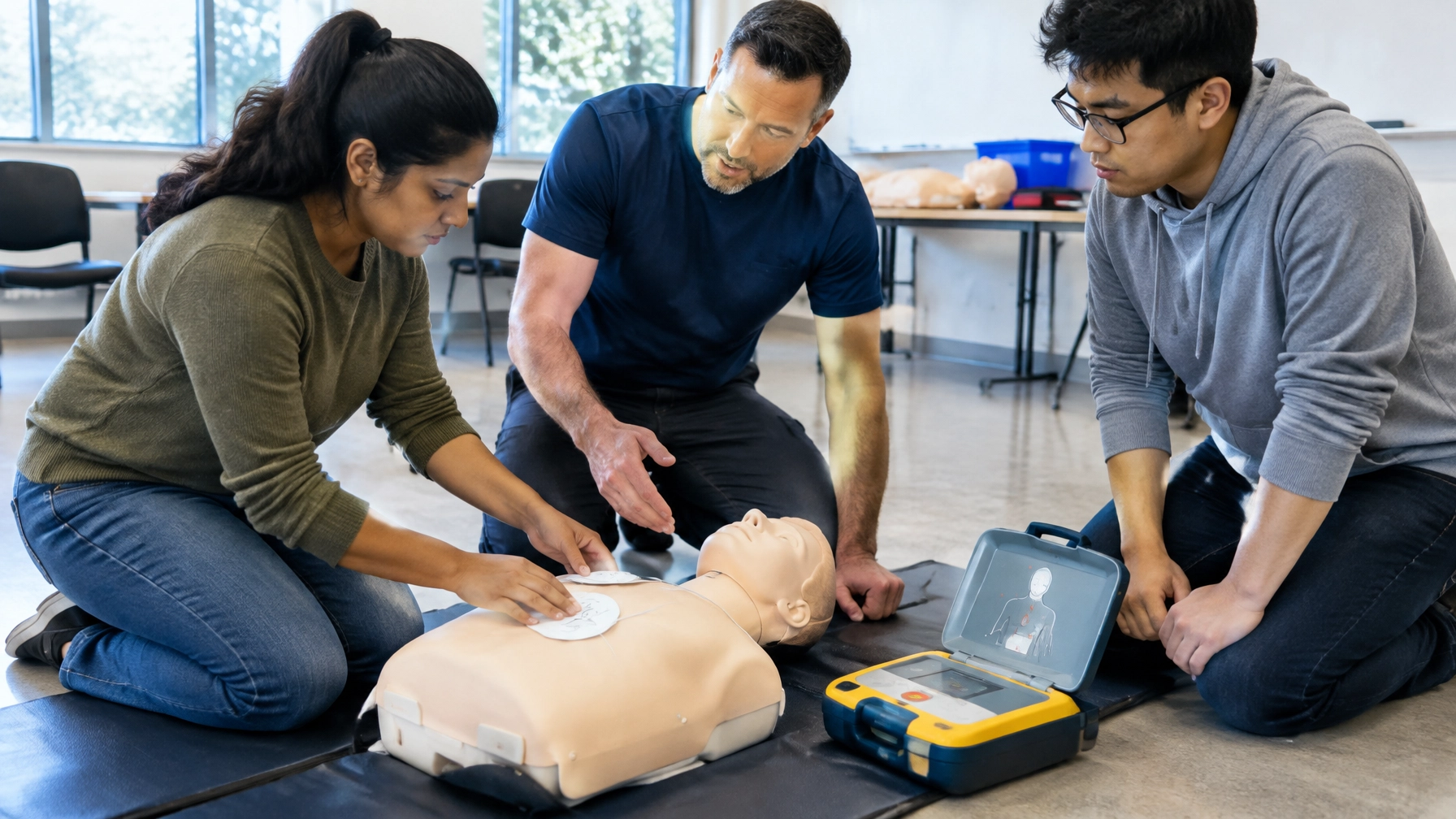
Open the AED pads and check the diagrams printed on them. For most adults, place the pads in an upper-right and lower-left position:
- First pad: On the upper-right side of the chest, just below the right collarbone and to the right of the breastbone.
- Second pad: On the lower-left side of the chest, below the left armpit and along the side of the chest.
Press the pads firmly onto bare, dry skin. Make sure the edges are not lifting.
For a small child or infant, use pediatric pads and pediatric settings if they are available. Follow the AED's instructions. If pediatric pads are not available, many AEDs can still be used with adult pads; however, make sure the pads do not touch each other. If the chest is too small for standard placement, follow the pad diagrams or place one pad on the chest and one on the back as directed by the device.
Step 6: Connect the Pads and Let the AED Analyze
Some AED pads are already connected to the device. Other models require you to plug the pad cable into the AED.
Once the pads are attached and connected, the AED may announce that it is analyzing the heart rhythm. Stop CPR and make sure everyone is completely clear.
Say loudly, “Clear!” Look around the person to confirm that nobody is touching them. Do not touch the person, the pads, or the bed or surface they are lying on during analysis.
Touching the person can interfere with the AED's analysis and may create a safety risk.
Step 7: Deliver a Shock If the AED Advises One
If the AED announces, “Shock advised,” make sure everyone is clear again.
Say, “Clear!” Look carefully to confirm that no one is touching the person. If the AED has a flashing shock button, press it when instructed. Some AEDs deliver the shock automatically, so listen for the device's instructions.
Never touch the person while the shock is being delivered. Do not worry about deciding whether the person needs a shock — the AED makes that determination.
If the AED says, “No shock advised,” do not press anything to force a shock. Immediately follow the next prompt and resume CPR.
Step 8: Resume CPR Immediately
After a shock, or after a “no shock advised” message, begin chest compressions again right away.
Start with compressions unless the AED tells you otherwise. Continue CPR while listening for additional instructions. The AED will periodically ask everyone to stop so it can analyze the heart rhythm again.
Each time the AED analyzes:
- Stop compressions.
- Make sure everyone is clear.
- Allow the AED to analyze.
- Deliver a shock if advised.
- Resume CPR immediately.
Keep the AED pads attached. Do not remove them, even if the person begins moving or breathing, unless emergency medical personnel instruct you to do so.
Continue until one of the following occurs:
- The person shows clear signs of life and begins breathing normally.
- EMS or another trained responder takes over.
- You are physically unable to continue.
- The scene becomes unsafe.
Common AED Questions from First-Time Users
Can an AED be used on someone with a pacemaker? Yes. Do not place the pad directly over the visible or raised area of an implanted device. Place it slightly to the side while keeping the pads in the recommended positions.
Can an AED be used on a wet person? Yes, but the chest must be quickly dried before applying the pads. Do not use an AED while the person is lying in a puddle or standing water.
Should I remove the AED pads after the shock? No. Leave the pads in place and continue following the AED prompts until EMS arrives.
What if the person wakes up? Stop CPR if the person begins breathing normally and shows clear signs of recovery, but leave the AED pads attached. Monitor the person and be prepared to resume CPR if they become unresponsive again.
Build Confidence Before an Emergency
Reading about AED use is helpful, but hands-on practice makes the steps easier to remember under pressure. I provide mobile CPR/AED training that comes directly to your location throughout San Diego County, Temecula, Murrieta, Menifee, Lake Elsinore, and Rainbow.
My courses are available for individuals and groups, including families, schools, daycare centers, offices, fitness centers, community organizations, and healthcare teams. With blended learning, participants complete online modules before attending an in-person skills session focused on CPR, AED operation, and practical emergency response.
Explore the First Aid, CPR & AED course to learn more about available formats and training options.
Training is appointment-only. To schedule a class, contact me or call (951) 669-4177. Please include the specific dates you want for the class, along with your preferred location, course, and approximate group size.
When an AED is nearby, your willingness to act can make a critical difference. Turn it on, follow its prompts, keep everyone clear during analysis and shock, and resume CPR immediately. You do not have to be perfect — you just have to start.
Explore Topics
Written by
David Onori
David Onori is a Trained Emergency Medical Responder (EMR) and Red Cross & HSI certified CPR and First Aid instructor serving Temecula, Murrieta, San Diego, and surrounding Southern California communities. He is a member of the Red Cross Ready Rating Business program. Every class is taught onsite — he comes to you.