Hands-Only CPR: How to Help Someone in Cardiac Arrest When You're Not Certified
· 9 min read · David Onori
When someone suddenly collapses and is not breathing normally, every second matters. You may not be certified in CPR, but you can still take immediate action that may help keep blood moving until emergency responders arrive.
Hands-only CPR is a simple form of CPR that uses continuous chest compressions without rescue breaths. For an untrained bystander responding to a sudden collapse in a teen or adult, it is an important first step: call 911, begin compressions, and use an automated external defibrillator (AED) as soon as one is available.
This guide is educational information, not a substitute for hands-on instruction. If you are facing an emergency, follow the directions of the 911 dispatcher. For training based on Red Cross or HSI programs, contact Code Blue Safety Skills.
What Is Hands-Only CPR?
Hands-only CPR is CPR without rescue breaths. It focuses on pushing hard and fast in the center of the chest to help circulate blood to the brain and other vital organs.
It is especially useful when:
- You are not trained in conventional CPR
- You are unsure of your CPR skills
- You are not comfortable giving rescue breaths
- You are responding to a teen or adult who suddenly collapses outside a medical setting
Hands-only CPR is better than standing by and doing nothing. It can help maintain circulation until emergency medical services arrive or an AED is ready to analyze the heart rhythm.
Hands-Only CPR vs. Conventional CPR
Conventional CPR includes both chest compressions and rescue breaths. It is commonly taught for trained responders and may be particularly important when cardiac arrest is caused by a breathing emergency.
Conventional CPR may be appropriate for:
- Infants and children
- Drowning incidents
- Choking or airway emergencies
- Drug overdoses
- Respiratory emergencies
- Situations where a trained rescuer is willing and able to provide breaths
If you are untrained, unwilling, or unable to give rescue breaths, start chest compressions rather than delaying care. The 911 dispatcher can help guide you through the response.
For detailed information on adult CPR steps, review the Red Cross CPR guidance.
Step 1: Make Sure the Scene Is Safe
Before approaching, quickly look for hazards such as traffic, fire, electrical wires, violence, or unsafe structures. Do not put yourself in danger.
If the scene is reasonably safe, move toward the person and check for a response.
Step 2: Check Responsiveness and Breathing
Tap the person firmly on the shoulder and speak loudly:
"Are you okay?"
Look for normal breathing. Occasional gasping, snorting, or irregular breaths are not normal breathing and may be a sign of cardiac arrest.
If the person does not respond and is not breathing normally, treat the situation as an emergency.
Do not spend a long time trying to find a pulse if you are an untrained bystander. Quickly recognizing unresponsiveness and abnormal breathing is enough to begin the next steps.
Step 3: Call 911 and Send Someone for an AED
If you are alone, call 911 on your mobile phone and place it on speaker. Tell the dispatcher that an adult is unresponsive and not breathing normally. Follow the dispatcher's instructions.
If another person is nearby, point directly to them and give a specific assignment:
- "You in the blue shirt, call 911."
- "You, find the nearest AED and bring it here."
- "Meet the ambulance outside and guide responders to us."
Clear assignments reduce confusion and help ensure that CPR, emergency communication, and AED retrieval happen at the same time.
Step 4: Position the Person
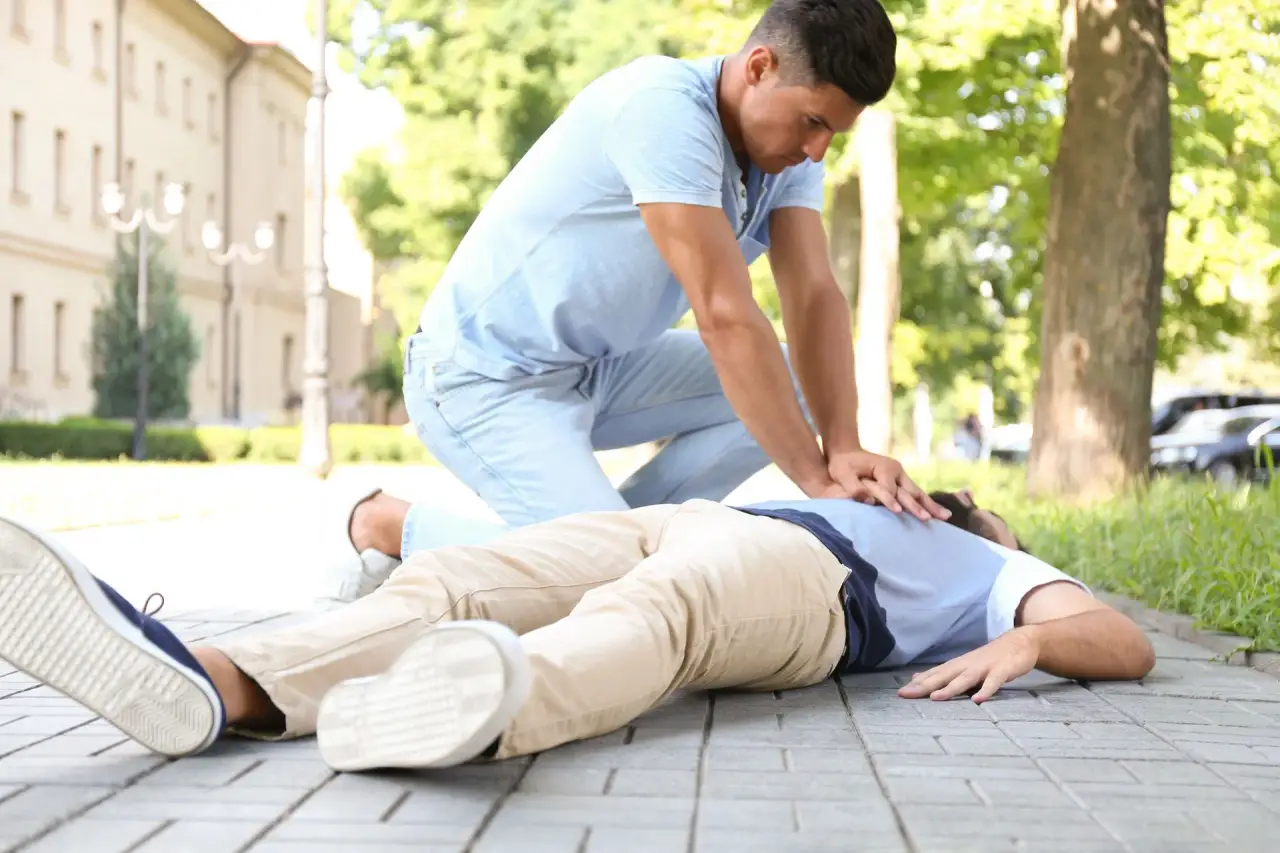
Place the person on their back on a firm, flat surface if it is safe to do so. Kneel beside the chest.
If the person is on a bed, couch, or other soft surface, move them to the floor when possible. A firm surface helps your compressions transfer effectively through the chest.
Step 5: Place Your Hands Correctly
For an adult or teen:
- Place the heel of one hand in the center of the chest, on the lower half of the breastbone
- Place your other hand on top
- Interlace your fingers and keep them lifted away from the ribs
- Position your shoulders directly above your hands
- Keep your elbows straight
Use your upper body weight to push straight down. Avoid leaning from the side or rocking back and forth.
Step 6: Push Hard and Fast
Begin continuous chest compressions:
- Rate: 100 to 120 compressions per minute
- Depth for an adult: About 2 inches
- Recoil: Allow the chest to return fully after every compression
- Interruptions: Keep pauses as short as possible
A steady rhythm is more important than trying to count perfectly. You can use the beat of a fast song as a general rhythm cue, but focus on maintaining a consistent pace.
Do not stop to check for a pulse after every few compressions. Continue pushing while another person speaks with 911 or retrieves the AED.
You may hear cracking sounds during CPR. Although this can be upsetting, stopping compressions may be more harmful than continuing. Keep your hands in position and follow dispatcher instructions.
Step 7: Use the AED as Soon as It Arrives
An AED is designed to be used by people who are not medical professionals. You do not need to diagnose the heart rhythm yourself.
When the AED arrives:
- Turn it on
- Expose the person's chest and wipe away excess moisture if needed
- Apply the pads exactly as shown in the diagrams
- Plug in the connector if required
- Follow the AED's voice and visual prompts
- Stop touching the person only when the AED says it is analyzing or delivering a shock
- Resume chest compressions immediately when instructed
Make sure no one is touching the person while the AED analyzes or delivers a shock. Review the Red Cross information on using an AED for additional guidance.
When Should You Switch Rescuers?
Chest compressions are physically demanding. If another person is trained, capable, and ready to help, switch rescuers about every two minutes or sooner if the person performing compressions becomes tired.
Plan the switch during a natural pause, such as when the AED is analyzing. Keep the interruption as brief as possible.
One rescuer should continue compressions while the other gets into position. Then switch quickly and resume the correct rate and depth.
If you are alone, continue until:
- Emergency responders take over
- The AED tells you to pause
- The person shows clear signs of life and begins breathing normally
- The scene becomes unsafe
- You are physically unable to continue
What If the Person Starts Moving or Breathing?
If the person begins moving, breathing normally, or showing other clear signs of life, stop compressions and monitor them. Leave the AED pads in place unless the device instructs you to remove them.
Keep the person in a safe position, continue following dispatcher instructions, and be prepared to restart CPR if the person becomes unresponsive and stops breathing normally again.
Common Concerns That Stop People From Acting
Many bystanders hesitate because they are afraid of making a mistake. Those concerns are understandable, but delaying care is often the greater risk.
"I am not certified." You do not need a certificate to call 911, begin hands-only CPR, or follow an AED's instructions. Dispatchers can provide real-time guidance.
"I might hurt the person." A person who is unresponsive and not breathing normally needs immediate help. Effective compressions require firm pressure. The goal is to circulate blood until professional care arrives.
"I do not know exactly what to do." Start with three actions: call 911, begin compressions, and send for an AED. The emergency dispatcher can help you take the next step.
"What if I do it incorrectly?" Perfect technique is not required before you begin. Place your hands in the center of the chest, push hard and fast, allow full recoil, and minimize interruptions. Training will improve your skill, but uncertainty should not prevent you from acting.
Build Confidence Before an Emergency Happens
Reading about CPR is useful, but practice builds confidence. Hands-on training gives you the opportunity to:
- Practice chest compressions on a manikin
- Learn how to recognize cardiac arrest
- Use an AED in a realistic scenario
- Practice working with a partner or team
- Receive feedback on hand placement, rate, depth, and recoil
- Rehearse communication with 911
- Build muscle memory for stressful situations
I personally lead every class at Code Blue Safety Skills, offering professional, interactive training based on Red Cross and HSI programs. Courses include First Aid and CPR/AED, Basic Life Support, Pediatric First Aid and CPR/AED, Stop Life-Threatening Bleeding, blended learning, and certification renewals.
I come to you — my mobile service travels to your location, making training convenient for families, schools, daycare centers, fitness facilities, offices, healthcare teams, and community organizations throughout San Diego County, Temecula, Murrieta, Menifee, and Lake Elsinore.
I offer flexible scheduling for individuals and groups, including blended courses that combine online learning with an in-person skills session. The goal is not just to complete a class — it is to help you feel prepared to respond in a real emergency.
To schedule an appointment-only class, email or call Code Blue Safety Skills and include the specific dates you want for the class. Whether you are learning CPR for the first time or need a certification renewal, practical training can help you move from hesitation to confident action.
Key Takeaway
If an adult or teen suddenly collapses and is unresponsive and not breathing normally:
- Make sure the scene is safe
- Call 911 or send someone to call
- Send someone to retrieve an AED
- Place your hands in the center of the chest
- Push hard and fast at 100 to 120 compressions per minute
- Allow the chest to fully recoil
- Follow AED and dispatcher instructions
- Continue until help takes over or the person shows clear signs of life
You do not have to be certified to help. You only need to recognize the emergency, call for help, and be willing to act.
Explore Topics
Written by
David Onori
David Onori is a Trained Emergency Medical Responder (EMR) and Red Cross & HSI certified CPR and First Aid instructor serving Temecula, Murrieta, San Diego, and surrounding Southern California communities. He is a member of the Red Cross Ready Rating Business program. Every class is taught onsite — he comes to you.