Why Watching a CPR Demonstration Is Not the Same as Being Trained
· 5 min read · David Onori
Why Watching a CPR Demonstration Is Not the Same as Being Trained
There is no shortage of CPR videos online. You can find step-by-step demonstrations on YouTube, social media, and health organization websites in a matter of seconds. Many of them are accurate, well-produced, and genuinely informative.
But watching a demonstration and being trained are two different things — and that difference matters when someone's life depends on what you do next.
I provide mobile First Aid, CPR/AED, BLS, Pediatric First Aid, and Stop the Bleed training throughout San Diego County, Temecula, Murrieta, Menifee, Lake Elsinore, and Rainbow, CA. Here is what hands-on practice gives you that a video cannot.
What a Video Can Do
A good CPR video can introduce the sequence of steps, show correct hand placement, explain compression rate and depth, and describe when to use an AED. For someone with no prior training, that information is genuinely useful as a starting point.
Videos are also a standard part of blended learning programs. Many Red Cross and HSI courses include an online component where learners watch instructional content before attending an in-person skills session. That format works well — but only because the video portion is paired with hands-on practice, not used as a substitute for it.
The problem is not the video. The problem is stopping there.
What a Video Cannot Do
It Cannot Build Muscle Memory
CPR is a physical skill. Effective chest compressions require the right hand position, the right depth — at least two inches for an adult — the right rate of 100 to 120 compressions per minute, and full chest recoil between compressions. Those are not things you can absorb by watching. They are things your body has to practice until they become automatic.
In a real cardiac emergency, you will be under stress. Your hands may be shaking. The person in front of you is not a manikin on a table — they are a real person, possibly someone you know, and the situation is nothing like the calm, well-lit video you watched at home.
Muscle memory is what carries you through that moment. You build it by doing, not by watching.
It Cannot Give You Coaching Feedback
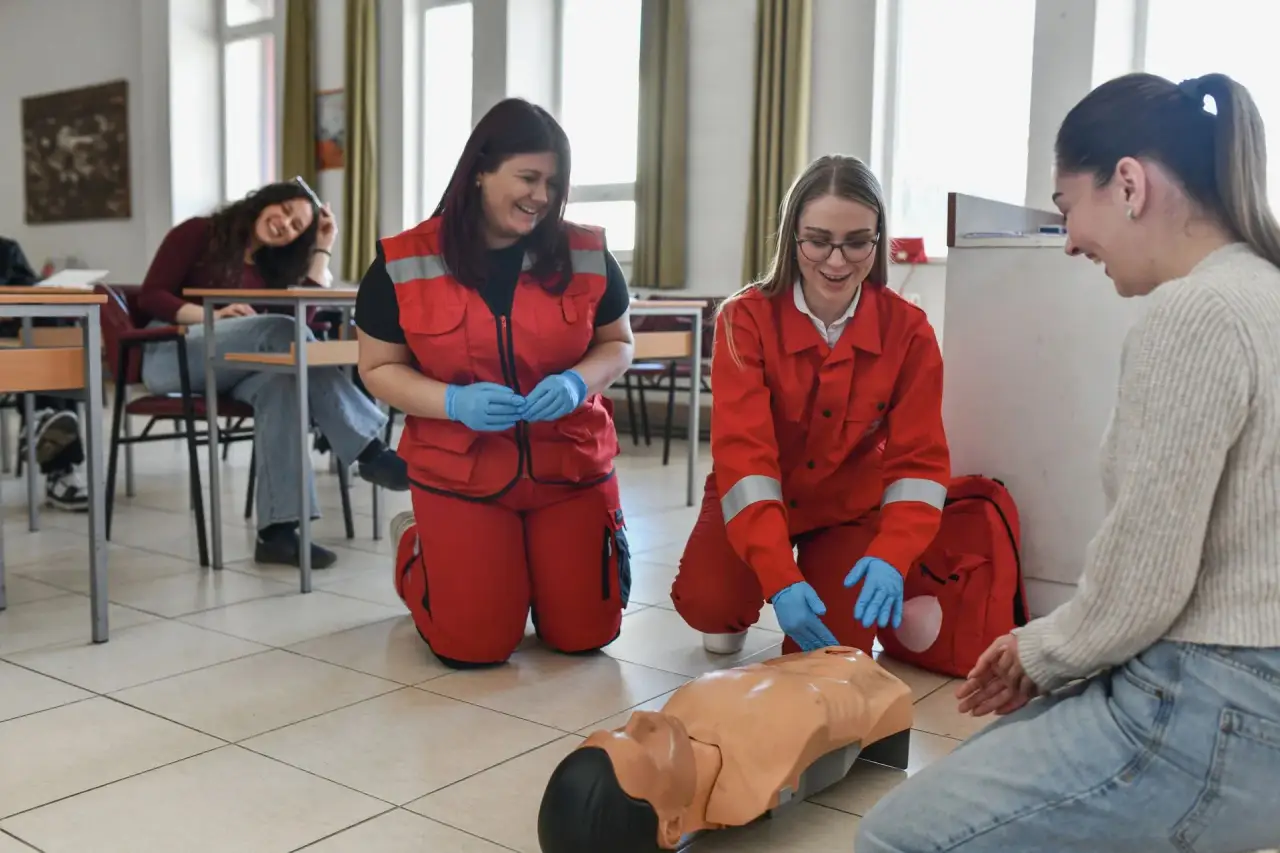
When you practice compressions on a training manikin with an instructor present, you get real-time feedback. Your hands are too far forward. You are not going deep enough. You are lifting your palms between compressions. Your rate is drifting.
A video cannot see what you are doing. It cannot tell you that your technique is off, that you are fatiguing faster than you realize, or that your hand position needs a small adjustment. An instructor can — and that correction in a training environment is what prevents the same error in an emergency.
It Cannot Simulate Pressure
Emergencies are disorienting. Even people who have watched CPR videos many times report freezing, forgetting steps, or feeling paralyzed by uncertainty when a real situation unfolds in front of them.
Hands-on training helps because it puts you through the scenario in a controlled setting. You practice recognizing an unresponsive person, calling for help, positioning yourself, beginning compressions, and using an AED — in sequence, under the guidance of an instructor who can walk you through the hesitation points before they happen in real life.
That rehearsal does not eliminate stress, but it gives you a reference point. You have done this before. You know what to do next.
It Cannot Certify You
A valid Red Cross or HSI certification requires demonstrated hands-on competency. Watching a video — even an official training video — does not fulfill the skills assessment requirement. An authorized instructor must observe you performing the required skills before a certification card is issued.
This matters for employers, schools, childcare programs, healthcare facilities, and anyone whose job or licensing requires a current certification. A screenshot of a completed online module is not a certification card.
The Difference Hands-On Practice Makes
I have taught CPR and first aid to parents, teachers, coaches, healthcare workers, office teams, faith communities, and individuals who simply wanted to be prepared. The pattern I see consistently is this: people who have only watched videos are often surprised by how physically demanding compressions are, how quickly their technique drifts without feedback, and how different it feels to work through a scenario from start to finish.
That surprise is exactly why the practice matters. Better to encounter it in a training room with an instructor than in a parking lot or a living room.
The goal of hands-on training is not to make you a paramedic. It is to give you enough practiced confidence that when something happens — and you are the person closest to it — you do not freeze. You act.
What I Teach and Where
I offer the following courses by appointment throughout San Diego County, Temecula, Murrieta, Menifee, Lake Elsinore, and Rainbow, CA:
- First Aid, CPR, and AED — for community members, parents, teachers, coaches, and workplace teams
- Basic Life Support (BLS) — for healthcare professionals and clinical staff
- Pediatric First Aid, CPR, and AED — for childcare providers, parents, and school staff
- Stop the Bleed — bleeding-control skills for workplaces, schools, and community organizations
All courses are mobile — I come to your location. Classes can be scheduled for individuals, families, small groups, or large workplace teams.
Ready to Get Trained?
If you have been meaning to get certified — or if your card is expiring and you want to renew with current techniques — view available courses here or contact me to schedule a class.
Watching a demonstration is a good first step. Hands-on training is what prepares you to act.
Explore Topics
Written by
David Onori
David Onori is a Trained Emergency Medical Responder (EMR) and Red Cross & HSI certified CPR and First Aid instructor serving Temecula, Murrieta, San Diego, and surrounding Southern California communities. He is a member of the Red Cross Ready Rating Business program. Every class is taught onsite — he comes to you.