California Just Overhauled Workplace First Aid Rules: What Employers Need to Know Before January 1, 2027
· 9 min read · David Onori
California employers are heading toward a significant change in workplace first-aid requirements.
On September 17, 2026, the Occupational Safety and Health Standards Board approved amendments affecting California Code of Regulations Title 8, including Sections 1512 and 3400. The changes are expected to take effect January 1, 2027, subject to the remaining filing and approval process through the Office of Administrative Law.
For employers, office managers, safety coordinators, and facility directors across San Diego County, Temecula, Murrieta, Menifee, and Lake Elsinore, the message is straightforward:
A first-aid kit is only one part of an emergency response program. The people who know how to use it — and who can begin CPR, use an AED, or control severe bleeding — are what make the supplies useful.
Here is what the approved changes mean and what employers should do before the expected effective date.
The Physician-Approval-Only Approach Is Changing
Under the updated framework, employers will have two primary ways to establish the minimum contents of workplace first-aid kits:
- Use a kit that meets the Class A baseline described in ANSI/ISEA Z308.1-2021, as incorporated into the California proposal; or
- Have the contents determined by an employer-authorized physician or other licensed healthcare professional.
This replaces the previous approach centered on physician approval of first-aid supplies.
The Class A option provides employers with a defined baseline of supplies, including:
- Adhesive bandages and medical tape
- Antiseptic and antibiotic applications
- Medical gloves and hand sanitizer
- Sterile pads and trauma pads
- A breathing barrier
- A burn dressing and burn treatment
- A cold pack
- Eye coverings and eye/skin wash
- A roller bandage and triangular bandage
- Scissors and a first-aid guide
- A foil blanket
The important distinction is that a Class A kit is a minimum baseline — not automatically a complete response solution for every workplace.
Employers Must Evaluate Hazards, Not Just Count Employees
The updated rules place greater emphasis on workplace-specific hazard assessment.
Employers must consider:
- The number of employees
- Where employees work
- Whether employees are spread across multiple buildings, floors, or job sites
- The types and severity of hazards present
- How quickly emergency medical services can reach the workplace
- Whether work occurs in mobile, temporary, construction, or remote locations
That assessment may require employers to provide:
- Additional first-aid kits
- More supplies than the baseline quantities
- Specialized equipment for reasonably anticipated serious hazards
- Clearer signage and communication about kit locations
For example, an office environment may primarily need a standard Class A kit, AED access, and trained responders. A construction site, warehouse, manufacturing operation, school athletic facility, or industrial workplace may need additional bleeding-control supplies, chemical-injury materials, burn-care equipment, or other specialized resources.
The regulation's basic principle is that employers should prepare for the emergencies their employees could realistically face — not simply purchase the smallest available kit and consider the issue complete.
If chemical-injury supplies are included, additional employee training requirements may apply under California's hazardous-substance rules. Employers should coordinate with their safety professional or licensed healthcare professional before adding specialized materials.
Kit Location, Access, Inspection, and Replenishment Matter
The proposed amendments also clarify several practical responsibilities.
Employers should ensure that first-aid kits are:
- Readily accessible to employees
- Located in sufficient numbers for the workplace
- Clearly marked or labeled
- Communicated to employees during onboarding and safety training
- Kept sanitary and usable
- Inspected regularly
- Replenished promptly after supplies are used
For construction, line crews, transient work, and short-duration jobs, the requirements are especially practical. Kits must be available in appropriate weatherproof containers, checked before being sent to a job, and inspected at least weekly while on the job under the modified text.
A kit that is technically compliant but locked away, poorly marked, inaccessible from a remote work area, or missing essential supplies is not an effective emergency resource.
ANSI/ISEA Z308.1-2026 Adds New Preparedness Guidance
Separately, the International Safety Equipment Association released ANSI/ISEA Z308.1-2026 on September 17, 2026.
This is a voluntary consensus standard and does not automatically change California law. The California amendments reference ANSI/ISEA Z308.1-2021, so employers should not assume that purchasing a product labeled to the 2026 edition alone satisfies every California requirement.
However, the new edition offers useful guidance for employers evaluating their broader emergency preparedness program. Updates address areas such as:
- Bleeding-control supplies and supplemental trauma equipment
- Tourniquet specifications
- Mobile and field-worker preparedness
- Naloxone as a recommended workplace emergency supply
- CPR and AED preparedness
- Staffing levels for trained responders
- Product-specific awareness training
- Anti-choking devices as supplemental equipment
The practical takeaway is that employers should view the 2026 standard as a planning resource, even while confirming which version California's final regulation formally incorporates.
California's Rule Does Not Make Every Specialized Supply Universal
The updated California language does not create a one-size-fits-all requirement for every possible emergency product in every workplace.
Instead, specialized supplies should be connected to the employer's hazard assessment or to recommendations from an authorized licensed healthcare professional.
That may include supplies for:
- Severe bleeding
- Chemical exposure
- Burns
- Opioid overdose response
- Remote or mobile work
- Other unique, reasonably anticipated, and potentially serious hazards
Employers should document why specialized supplies are, or are not, needed. Written documentation can help demonstrate that the workplace evaluated its actual risks rather than making an unsupported purchasing decision.
The Most Important Compliance Issue: Trained Responders
A kit can contain the right supplies and still fail in the moment if no one knows what to do.
Employers should identify an appropriate number of trained responders based on:
- Workplace size
- Number of shifts
- Employee locations
- Remote or isolated work areas
- Expected response times
- Vacation, leave, and turnover
- The types of emergencies employees may encounter
Training should be practical and skills-based. Depending on the workplace, employers may benefit from:
- First Aid, CPR, and AED training for all designated responders
- Basic Life Support for healthcare teams
- Stop Life-Threatening Bleeding training for higher-risk workplaces
- Pediatric First Aid and CPR/AED training for schools, daycares, and youth programs
- Product-specific AED orientation
- Emergency action plan drills
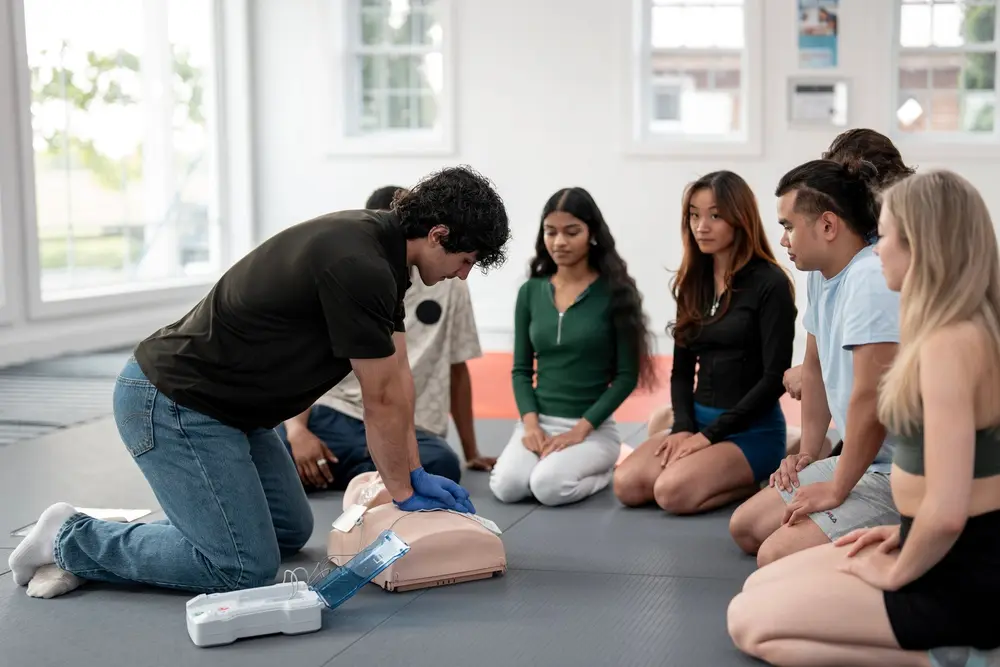
I personally lead every class through American Red Cross and HSI programs, with hands-on instruction designed for real-world emergencies. I come to you — courses can be delivered at a workplace, school, office, facility, church, or other group location across San Diego County, Temecula, Murrieta, Menifee, and Lake Elsinore.
What About AB 387 and Youth Sports AED Access?
Employers and facility directors may have seen reports about AB 387, youth sports, AED access, and cost-sharing between facilities and leagues.
As of October 9, 2026, the official California legislative record does not support the claim that AB 387 was signed on September 27, 2026. AB 387 appears to have remained an active bill rather than an enacted law.
The youth-sports measure that appears to be relevant is AB 310, the Nevaeh Youth Sports Safety Act, which was enacted in 2025. Facilities hosting youth sports should review the applicable requirements regarding AED access, coach CPR/AED certification, emergency response planning, and AED maintenance.
This distinction matters because employers should base compliance decisions on enacted statutes and final regulations — not summaries that may contain an incorrect bill number or date.
SB 945 Advances CPR and AED Education in High Schools
SB 945 addresses CPR and AED education in California public high schools.
Beginning with the 2027–28 school year, school districts and charter schools serving grades 9–12 are expected to provide compression-only CPR and AED-use instruction as part of a course required for graduation. The legislation also includes hands-on skills instruction and directs the state to develop implementation guidance.
For schools, this reinforces an important point: emergency preparedness is not only about equipment placement. Students, staff, coaches, teachers, and administrators should understand how to recognize cardiac arrest, activate emergency services, begin CPR, and retrieve and use an AED.
Employer Checklist Before January 1, 2027
Use this checklist to begin preparing:
- Monitor the final Office of Administrative Law filing and effective-date notice
- Inventory every first-aid kit, AED, bleeding-control kit, and emergency supply location
- Compare current kit contents with the final California Class A baseline
- Decide whether to use the Class A option or have supplies determined by a licensed healthcare professional
- Complete and document a workplace-specific hazard assessment
- Identify whether specialized supplies are needed
- Confirm that kits are accessible, visible, sanitary, and clearly marked
- Establish an inspection and replenishment schedule
- Verify AED readiness, including battery, pads, signage, and access
- Identify enough trained responders for every shift and work area
- Provide hands-on First Aid, CPR, and AED training
- Consider Stop Life-Threatening Bleeding training for higher-risk environments
- Review emergency action plans and practice communicating the workplace location to 911
- Train employees on the location of kits and AEDs
Make Your Workplace Response-Ready
California's upcoming changes are a reminder that compliance is not just a purchasing exercise. A first-aid kit is the starting point. Prepared employees, accessible equipment, clear procedures, and regular training are what turn that kit into a lifesaving response system.
I offer mobile, on-site group training throughout San Diego County, Temecula, Murrieta, Menifee, and Lake Elsinore. Training options include First Aid, CPR & AED, Basic Life Support, Pediatric First Aid and CPR/AED, Stop the Bleed, blended learning, and certification renewals.
Appointments are required. To schedule a class, email Code Blue Safety Skills or call (951) 669-4177, and include the specific dates you want for the class, along with your preferred location, course, and approximate group size.
View available courses or request an appointment.
This article provides general industry information and is not legal advice. Employers should review the final regulation, consult qualified safety professionals, and confirm requirements with Cal/OSHA or legal counsel before making compliance decisions.
Sources
- California Occupational Safety and Health Standards Board: September 2026 notice
- Modified text of proposed California Title 8 first-aid regulations
- ISEA: Updated Workplace First Aid Standard Adds Naloxone
- California SB 945 bill text
- California AB 387 bill status
- California AB 310 bill text
Explore Topics
Written by
David Onori
David Onori is a Trained Emergency Medical Responder (EMR) and Red Cross & HSI certified CPR and First Aid instructor serving Temecula, Murrieta, San Diego, and surrounding Southern California communities. He is a member of the Red Cross Ready Rating Business program. Every class is taught onsite — he comes to you.